Most professionals spend their careers responding to opportunities someone else defines. They build expertise, execute well, and wait for the next promotion to arrive when they've proven they're ready.
Mrs. Morenike Ominike discovered a different path. Not "What's the next step?" but "What do I want to own?"
That question, shifting from chasing advancement to defining accountability, transformed how she navigated every transition at VFD Group. From Head of Regulatory Compliance to Chief of Staff to the Group Managing Director, to Chief Operating Officer, and now Executive Director, Operations.
"At some point, I stopped thinking about promotions and started thinking about ownership," she says. "Ask yourself: What do I want to be accountable for in the next 2–3 years? That clarity changes how you move."
Her progression wasn't about climbing a ladder someone else built. It was about identifying the seat she wanted, then positioning herself to own it before anyone offered.
"My journey at VFD Group has been one of deliberate growth, strategic evolution, and a willingness to step into unfamiliar territory in service of the broader vision of the institution."
Each transition required adaptability, courage, and what she describes as "a commitment to institutional impact over personal comfort." But more than that, each move required clarity on what she wanted to own, not what someone else decided she was ready for.
"The path that brought me here was not linear, it was intentional."
When you give yourself permission to define your seat instead of waiting for the next step, you gain something most professionals never access: positioning power. The ability to shape your trajectory instead of reacting to it.
The ability to step into leadership before anyone taps you for it.
When You Give Clarity on What You Want to Own, You Gain Positioning Power
When Mrs. Morenike joined VFD Group as Head of Regulatory Compliance, the Group was expanding across financial services verticals and strengthening its governance architecture. Her mandate was clear: build a resilient compliance framework.
"In that role, my focus was clear: build a resilient compliance framework, deepen regulatory relationships, and institutionalize a culture where governance was not a constraint, but an enabler of sustainable growth," she says. "We worked to harmonize compliance standards across subsidiaries, improve regulatory reporting cadence, and embed proactive risk identification into operational processes."
But what she was really doing, beyond executing the role, was learning how the institution worked. How decisions are made. Where risk sat. Who held influence.
"Early on, I realized it's not just about doing your job well, it's about understanding how decisions are made, where risk sits, and who holds influence. That knowledge gives you confidence in senior conversations and positions you for leadership."
She gave herself a broader lens than her job description required. What she gained was institutional literacy that would matter when opportunities opened up beyond compliance.
When You Give Yourself Permission to Step into Unfamiliar Territory, You Gain Enterprise Understanding
When the Chief of Staff role to the Group Managing Director opened up, it had nothing to do with compliance.
"It was a significant shift in trajectory," she recalls. "Moving from a functional leadership role into a strategic, enterprise-wide coordination position."
Most people wait until they've mastered their current role before considering the next. Mrs. Morenike did the opposite.
"It was a challenge I was willing to take. The role demanded a broader lens: driving execution discipline across business units, aligning strategy with operational delivery, and ensuring Board and executive priorities translated into measurable outcomes."
She gave herself permission to step into unfamiliar territory. What she gained was something you can't get by staying in one functional lane: understanding of how the entire ecosystem worked; digital banking, investment services, capital markets, proprietary investments and the ability to manage complexity at scale.
"After successfully executing that mandate, I transitioned into the role of Chief Operating Officer, where my focus expanded to operational excellence, performance optimization, and cross-functional integration. This was about institutionalizing structure, building systems that were scalable, measurable, and resilient."
Each move required adaptability and what she describes as "a commitment to institutional impact over personal comfort."
"The path that brought me here was not linear, it was intentional. Each transition required adaptability, courage, and a commitment to institutional impact over personal comfort. From compliance leadership to enterprise strategy, to operations and board-level oversight, the common thread has been building systems that endure."
Today, as Executive Director, Operations, her mandate sits at the intersection of governance, execution, and transformation. Not because she followed a prescribed path. Because she defined what she wanted to own, then positioned herself to get there.
Give in to Rigorous Partnership Standards, Gain Accelerated Growth
One thing Mrs. Morenike learned navigating multiple leadership transitions: not everyone accelerates your trajectory.
"One thing I learned is that not everyone accelerates your growth. The right people will challenge you, open doors, and advocate for you. The wrong ones will limit you, subtly."
Working with Structure HQ, a female-led corporate governance firm exemplified what the right partnership looks like.
"Working with Structure HQ has been both professionally valuable and personally affirming," she says.
On the technical side: "What stands out to me is their ability to combine technical depth with commercial understanding. In financial services, governance isn't just a requirement, it's the backbone of operational stability. Structure HQ approaches it that way. Their support across board structuring, regulatory filings, and governance advisory has strengthened our processes in a way that is precise, proactive, and clearly aligned to how the business actually operates."
But there was something else that mattered. "What I particularly value is their forward-looking approach. They don't just respond to requirements, they anticipate regulatory sensitivities and guide us through them. That has given me greater confidence in our decision-making and reinforced the integrity of our governance framework."
And working with women who understood both the technical demands and the leadership nuances? "On a personal level, working with a female-led firm brings a different kind of ease and alignment. There's a shared understanding of both the technical demands of the role and the nuances of leadership as a woman. It removes the need to over-explain and allows for more direct, solution-focused engagement. There's mutual respect, clarity, and a strong bias for excellence."
The difference is context and understanding. "They bring not just expertise, but context. Not just structure but understanding. Ultimately, their value goes beyond execution, they strengthen our governance confidence and contribute meaningfully to the credibility of the organization."
When you give yourself high standards for who you work with. You gain relationships that accelerate rather than limit.
What Aspiring Executives Across Industries Need to Know
For professionals aspiring to executive roles, whether in operations, strategy, compliance, technology, or any function, Mrs. Morenike identifies three elements that separate those who advance from those who stall:
1. Governance Understanding: Know How Decisions Actually Get Made
"It's not just about doing your job well, it's about understanding how decisions are made, where risk sits, and who holds influence. That knowledge gives you confidence in senior conversations and positions you for leadership."
This is beyond corporate politics. It's about understanding the system you're operating in so you can navigate it effectively.
2. Strategic Positioning: Make Your Work Matter Where It Counts
"Working hard isn't enough. You have to be intentional about where you show up. I focused on high-impact work, built the right relationships, and made sure my contributions were visible. That's what creates real career momentum."
Not visibility for its own sake. Strategic positioning being known for outcomes that matter to the organization.
3. Credibility: Deliver So Consistently They Trust Your Judgment
"Your reputation is built on consistency. Know your craft, deliver results, and communicate clearly. Over time, people don't just see your competence, they trust your judgment."
Competence gets you in rooms. Credibility gets you listened to.
Her synthesis: "When you combine deep understanding, visible impact, and trusted delivery, you become difficult to ignore and even harder to replace. That's what ultimately drives progression into leadership."
Build Beyond Your Lane, Gain Leadership Leverage
One of the patterns Mrs. Morenike emphasizes for aspiring executives: don't stay in one functional area.
"My growth came from moving across compliance, operations, and leadership. Understanding how risk, operations, technology, and revenue connect gives you real leverage. Don't stay in one lane."
She expanded her scope deliberately. "Focus on building real competence, whatever your entry point is, understand it deeply. Then go beyond your role. I moved from compliance to operations to leadership because I stayed curious and kept expanding my scope. Also, learn how the business makes money. That commercial awareness is what separates you over time."
When you give yourself a broader context than your role requires. You gain leverage that comes from understanding how the pieces connect.
For Those Who Don't See Themselves Reflected in Leadership Yet
Mrs. Morenike didn't always see people who looked like her in the rooms she was entering.
"Speaking from my own journey, I didn't always see people who looked like me in the rooms I was entering, and that can feel intimidating at first. But I learned quickly that the industry makes space for those who show up, build capability, and consistently deliver."
What you should prepare for: "You're stepping into a performance-driven environment where results matter. At the early stages, you may have to prove yourself more deliberately, and you may not always have visible role models, but that shouldn't slow you down."
The mindset shift that mattered most: "I stopped trying to 'blend in' and started focusing on ownership and impact. That's what people actually respond to."
Mrs. Morenike's Challenge: Define Your Seat in the Next 30 Days
When asked what she'd challenge aspiring executives to do right now, Mrs. Morenike is specific.
"I had to learn this myself: no one ever really feels ready for the next level. The difference is in who steps forward anyway." Her challenge: "Don't wait until you feel fully ready, step forward early, take responsibility, and make your work visible. That's how you accelerate. Not just by working hard, but by being intentional about how you grow, how you show up, and how you position yourself for the next level."
Here's what she wants you to do, starting now:
Define your next seat, not just your next step
"At some point, I stopped thinking about promotions and started thinking about ownership. Ask yourself: What do I want to be accountable for in the next 2–3 years? That clarity changes how you move."
This is the shift that changes everything. Not "What's the next promotion?" but "What do I want to own?"
Ask for responsibility early
"One of the most powerful shifts is simply saying: 'I want to lead this.' That signal changes how people perceive your readiness."
Give yourself permission to ask before anyone offers. Gain positioning as someone ready to lead.
Build beyond your core function
"Understanding how risk, operations, technology, and revenue connect gives you real leverage. Don't stay in one lane."
Surround yourself with advocates
"Mentors are important, but you also need people who will speak for you when you're not in the room. That makes a real difference at senior levels."
Make sure the right people see your work
"Good work alone isn't enough if the right people don't see it. Speak up. Share your thinking. Make sure your name is attached to outcomes."
The Commitment: Take One Uncomfortable Positioning Step
Mrs. Morenike's call to action is direct: "In the next 30 days, take one step that feels uncomfortable but makes you more visible as a leader. Not more learning. Not more planning. Positioning."
Because here's what she's learned across a decade moving from compliance to executive leadership: "Careers don't accelerate on competence alone. They move faster when you combine visibility, intentional decisions, and the courage to take ownership early."
Stop waiting for someone to tap you for the next step. Define the seat you want. Position yourself to own it. Then step forward before you feel fully ready. "Do that consistently, and you won't just be in the room, you'll start influencing what happens in it."
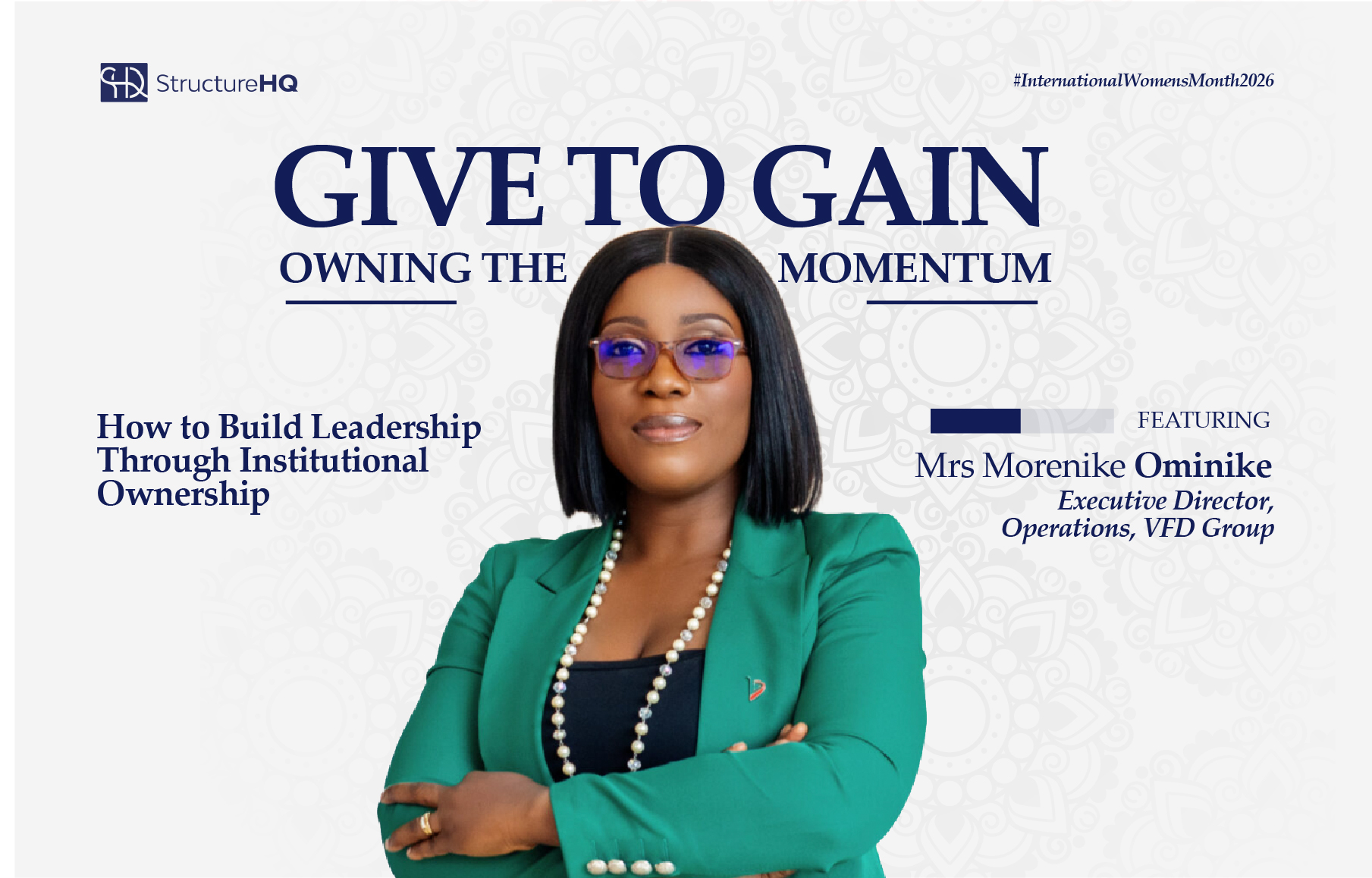
About Mrs. Morenike Ominike
Mrs. Morenike Ominike is Executive Director, Operations at VFD Group, where her mandate sits at the intersection of governance, execution, and transformation. Her career spans regulatory compliance, enterprise strategy as Chief of Staff to the Group Managing Director, and operational leadership as Chief Operating Officer. She focuses on building scalable systems across digital banking, investment services, capital markets, and proprietary investments.