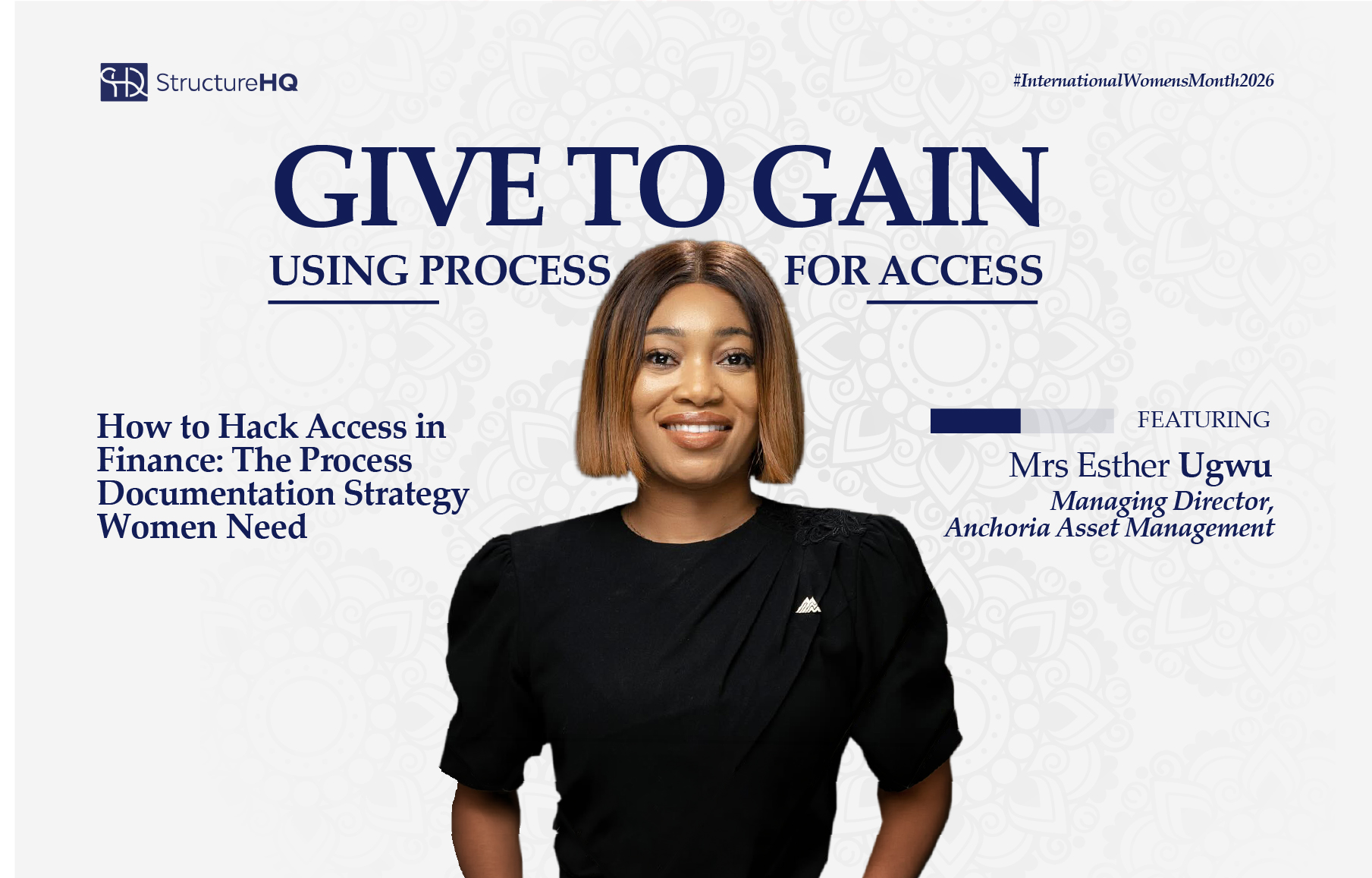
Mrs. Esther Ugwu noticed something during her early years in client experience at one of Nigeria's premier asset management firms: clients didn't understand why setting funds aside for investment mattered. Not because they lacked intelligence, but because no one had walked them through the process of how capital deployment actually worked, what it would accomplish, and why it mattered for their goals.
"Through my interactions with clients, I observed that many did not fully understand the importance and benefits of setting funds aside for investment. This realization influenced my decision to move deeper into investment management, with a focus on advising and guiding individuals and businesses on how to effectively deploy and optimize their funds to generate sustainable returns."
When clients understood the process, they gave access to their capital, to long-term relationships, and to trust. When they didn't, they hesitated. The lesson was clear: give people visibility into your process, gain access to what you need to succeed.
That pattern; give process, gain access would show up again. But the next time, she'd be the one without access.
From Invisible to Essential: Hacking Growth as an Intrapreneur
Years into her investment management career, Mrs. Esther was delivering strong results. She had a solid track record. However, she operated under an assumption most high-performing professionals make that excellent work speaks for itself.
Then her boss said something that stopped her: he didn't fully understand what she was doing. "I had a strong track record and was delivering results, but I believed that my work should speak for itself. I didn't put much effort into creating visibility around what I was doing because I assumed performance and recognition would naturally go hand in hand."
The problem wasn't her work. She had the results. But without visible process, she didn't get credit for how she produced those results. And in organizations, whether you're deploying capital or building products if stakeholders can't see your process, they don't trust you with more responsibility.
"That was a turning point for me. It made me realize that performance alone is not always enough; visibility and communication are equally important."
Her response was deliberate.
"From that moment, I became more deliberate in how I showed up. First, I strengthened my pre-meeting influence—engaging key stakeholders one-on-one to walk them through my thinking ahead of formal discussions."
Pre-meeting influence. Not post-meeting defense. She gave stakeholders visibility into her process before decisions were made.
"Interestingly, the narrative and perception changed significantly not because I started doing more work, but because I became more deliberate about communicating the value of what I was already doing. From that point on, there was a noticeable shift not just in how my voice was received, but in how I was proactively included in critical decisions."
Give visibility into your process. Gain access to the rooms where decisions are made.
Give in to Process Documentation, Gain Enduring Credibility
As Mrs. Esther moved into advising businesses on capital optimization at Anchoria Asset Management, she applied what she'd learned to her clients: documented process opens doors.
"Consistency matters more than occasional wins. It's not just about generating returns but demonstrating disciplined decision-making across cycles. When you document your investment rationale, risk frameworks, and outcomes. Over time, people don't just trust your results; they trust your process. That's what builds enduring credibility with both investors and peers."
One strong quarter can tell stakeholders you got lucky. Five years of documented decisions, showing what you considered, what you rejected, how you managed risk, how you adapted will tell them you have a process they can trust with larger allocations.
For intrapreneurs building within organizations, the same logic applies. When you document your process, the frameworks guiding your decisions, the alternatives you evaluated, the tradeoffs you considered. Stakeholders understand your thinking. When they understand your thinking, they trust your judgment. When they trust your judgment, you gain access to bigger opportunities.
But Esther also learned something else: having a strong process isn't enough if you don't have the infrastructure to protect it. Especially when short-term pressure tries to override sound long-term decision-making, you need governance frameworks that protect your ability to execute.
That's where working with Structure HQ made the difference. As her responsibilities expanded and the complexity of navigating investment decisions grew, she needed partners who understood governance as a strategic protection.
"I must commend my experience working with SHQ, which has been very positive, particularly as a female-led firm. Their support has been exceptional and has reinforced my belief that 'women supporting women' is more than just a phrase—it is a reality as I have witnessed intentionality firsthand in creating opportunities, sharing knowledge and advocating for others."
Beyond the technical work, what stood out was how they operated. "SHQ is consistently accessible and responsive, demonstrating a clear understanding of the unique dynamics and complexities of the business. One aspect I particularly admire is their professionalism and solution-oriented approach in handling matters."
And critically, they understood what governance actually does for professionals navigating high-stakes decisions. "They place a strong emphasis on corporate governance and ensure that it is upheld to the highest standards. For me, this highlights a key advantage of working with women who not only understand the technicalities of governance but are also intentional about providing practical solutions to navigate the unique challenges women face in the finance industry."
In environments where quarterly pressure can override sound strategy, governance frameworks protect your ability to make decisions based on process, not panic. That protection matters whether you're deploying capital or building products within an organization.
Give yourself governance infrastructure. Gain protection for disciplined decision-making.
Give in to Careful Partner Selection, Gain Accelerated Trajectory
For intrapreneurs navigating organizational dynamics, partnership selection either accelerates trajectory or stalls it. The partners you choose, whether collaborators, advisors, or sponsors determine whether you gain access to opportunities or get stuck in transactional relationships that consume time without advancing impact.
Mrs. Esther evaluates potential partners across three dimensions:
- Alignment of incentives: are they optimizing for long-term value creation, or short-term wins that create pressure for bad decisions?
- Intellectual honesty: can they challenge your thinking constructively, or do they agree in meetings then undermine in execution?
- Access: do they open networks, opportunities, or insights you wouldn't otherwise reach?
Red flags matter equally. "If a potential partner consistently dominates conversations without adding substance, lacks clarity on how they create value, or has a track record of transactional rather than strategic engagement, that's usually a sign they will consume time without accelerating impact."
When you give yourself a rigorous partner selection criterion, you will gain relationships that accelerate rather than consume.
What Intrapreneurs Must Know About Building Influence
For professionals building within organizations, whether in finance, tech, operations, or any field. Mrs. Esther’s lesson is direct:
"Performance alone is not enough. You must be intentional about communicating your impact, whether it's through meetings, stakeholder engagement, or simply speaking up. Visibility is not about noise—it's about ensuring your value is understood. People often assume that if they deliver strong results, those results will naturally be recognized. But in reality, value must be communicated to be appreciated."
Technical competence is table stakes. "The reality is that technical competence alone is not always enough. You must be intentional about visibility, sponsorship, and influence. Build relationships before you need them, communicate your perspective with clarity and conviction, and ensure your contributions are both visible and attributable."
For those waiting to feel 100% ready before stepping into larger roles:
"You don't need to wait until you feel 100% ready. If you are in the room, you belong there. Speak, contribute, and don't shrink yourself even in unfamiliar environments. We often delay stepping forward because we are waiting for complete certainty. But in reality, leadership is not built on perfect readiness—it is built on willingness to step up, learn, and contribute in real time."
The uncomfortable roles? Those are precisely the ones that build capability.
"Some of your biggest growth will come from roles you initially feel unprepared for. Take them. Stretch yourself. Leadership is developed in uncomfortable spaces. The roles that feel daunting or outside your comfort zone are exactly the ones that accelerate your development. Growth doesn't happen when everything feels safe and predictable—it happens when you are challenged to learn, adapt, and perform at a higher level."
And when scrutiny arrives, because especially for women in competitive fields, it will: "In any leadership journey, especially in male-dominated industries like finance, there will be times when your abilities are questioned, your decisions scrutinized more closely, or your contributions overlooked. These moments are not a reflection of your competence—they are a reality of the environment. The key is not to internalize these perceptions but instead, stay focused on results, build allies, and keep positioning yourself strategically."
In Giving and Gaining: Be Deliberate
Mrs. Esther challenge to women who want to excel as talented intrapreneurs is simple but profound. She says: "Be deliberate about building competence, deliberate about creating visibility, and deliberate about supporting other women."
- Be deliberate about process: Document your decision-making. Build frameworks. Show your thinking across time, not just in moments.
- Be deliberate about visibility: Engage stakeholders before formal decisions. Walk them through your rationale. Make your process legible. Ensure attribution for your work.
- Be deliberate about support: When you gain access to bigger opportunities, use that leverage to advocate for others, especially women doing excellent work that's staying invisible.
"When more women lead with intention, we don't just change our individual outcomes—we transform the industry."
Because here's what's at stake: when talented professionals with sound processes stay invisible because they assumed their work spoke for itself, organizations make worse decisions. Capital gets allocated poorly. Products get built without the best thinking. Industries replicate the same patterns.
So, help the world avoid such chaos. Be deliberate.
About Mrs. Esther Ugwu
Mrs. Esther Ugwu is an investment management professional at Anchoria Asset Management, where she advises individuals and businesses on strategic capital deployment and fund optimization. Her career spans client engagement and core investment roles at premier asset management firms in Nigeria, with focus on helping clients understand and leverage investment opportunities for sustainable returns.